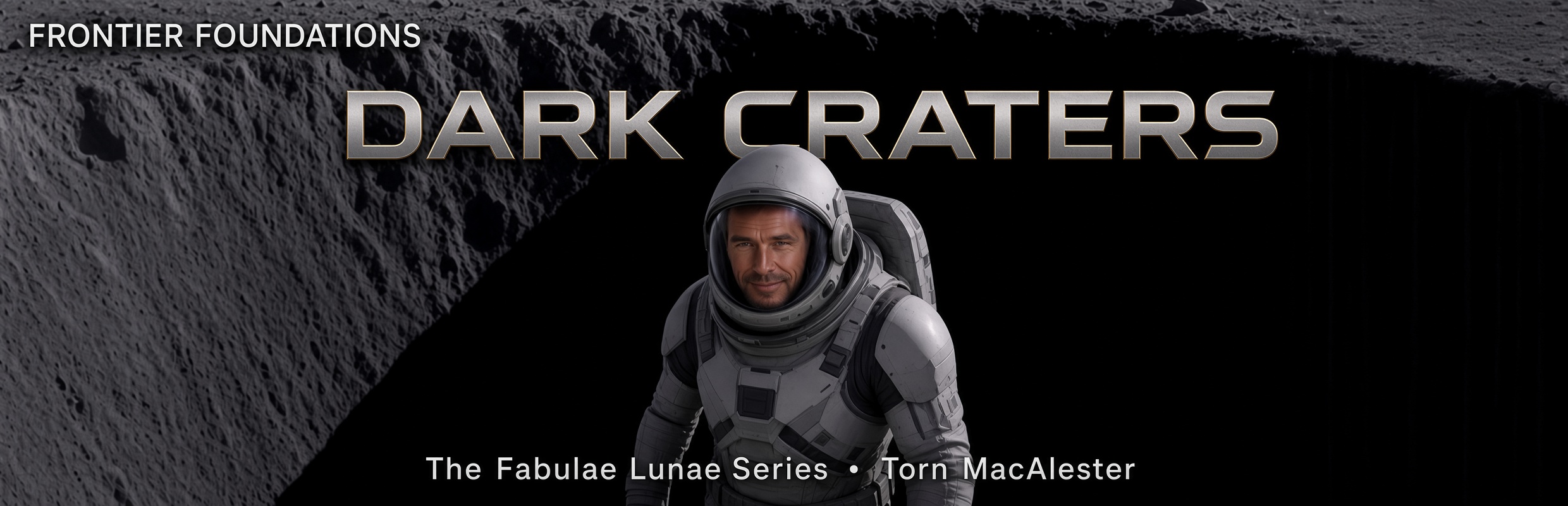
Frontier Foundations – Dark Craters
Permanent shadow, a stuck rover, and the first polar descent Nils was actually qualified to fly.
Moon base hard science fiction: air, water, power, and the narrow buffers that keep the Habs alive.
The equatorial belt is where most of the early work happened. Conrad Station still sits there, in Oceanus Procellarum, under a Sun that rises and sets on a two-week clock. The ice is not there. The ice is in the dark.
In Descent into Darkness, Nils Carmike is not yet the prospector spinning yarns at Alex’s Bar. He is a man who lost a lunar seat, took a reprimand, and then got picked anyway — because he had studied PSR ice retrieval, and commander Mose (seventy-one, every class of vehicle since the Shuttle) had a guarantee from the Astronaut Office: what I say goes. Including the crew.
The Detection / The First Lesson
Permanent shadowed region. Dark crater. Same place, two names. A floor that never sees the Sun, cold enough that Mose, looking down into Shackleton from the pressurized rover, has to connect it out loud: colder than Pluto, and still close enough to Texas that the comparison feels wrong.
The agency had been aiming at those craters for years. Each mission was supposed to be the next step toward self-sufficiency. Everyone knew what that meant in the briefing slides: water for rocket fuel. Nils knew it was more than that. A gallon a day that does not have to be shipped. Under Tsiolkovsky’s equation, water is easily half the consumable mass a person requires. Find it in the dark, and the entire logistics of staying on the Moon changes. Fail to sample it, and every radiation shelter, landing pad, and power farm you build at the pole is a bet you have not yet earned.
A robot rover had already gone down. It failed to return a core. It was still down there.
The Local Problem
The back room wanted three EVAs: surface experiments, the PSR, and a geology traverse. Dennis Vargas wanted the stuck rover. John Block would have gone along. Mose cut through it: the mission is the core sample. The rover may or may have recovered nothing. Go after the rover and you risk not getting a core.
Nils split the difference the way a man who has already lost one Moon flight splits differences: descend near the rover, take a core, hook up, drive out. Riskier. Polar lighting, polar thermal, polar comms: none of it was the equatorial belt they already knew. Two rovers were already on site, one on the rim, one on the floor. The rim rover had been used to steady the one that went down. Nils’s lander would bring only one pressurized rover. Use what is already there, Mose said, and keep the tele-operators out of the hole. Astronauts covering astronauts.
On the way out, Nils regretted the rover the way you regret an extra EVA you cannot take back. He could not sleep with the Moon in the window. Mose sent him amidships, out of line of sight, and told him to keep his eyes closed. What I say goes.
They landed. Houston gave them a stable six hours. Then Nils looked out at a rough circle of light around Shackleton’s rim, and a crater floor that was blacker than the stars beyond it. The lander’s own shadow ran a hundred meters toward the dark. He called it the mouth of Hell, after he checked the microphones were not on VOX.
The story ends there, on the rim, with the work still below them. That is the point. The first polar descent in the Fabulae Lunae chronicle is not a triumph montage. It is a man staring into a place that never sees the Sun and deciding, again, not to miss it.
What Still Follows
Conrad Station still lives on imported margins. The water economy at the equator is recycling, rationing, and argument. The dark craters are why anyone ever believed the Moon could be more than a waystation. Every claim, every cold trap, every rumor of ice that later becomes a corporate interest — including the real detections Nils will one day dress up as someone else’s lunchbox — sits downstream of that first look into permanent shadow.
The rover is still a parable. Hardware already on the floor is not free. Retrieving it costs core, time, and thermal margin. Leaving it costs a sample you may never get back. Three days from Earth, you do not get a third option.
Under Conrad’s boots the same question remains unfinished: how much ice is actually in the dark, and what are you willing to spend to find out before you build the rest of the station on the answer?
Further Reading
- The Lunadyne Incident and Other Stories — “Descent into Darkness”
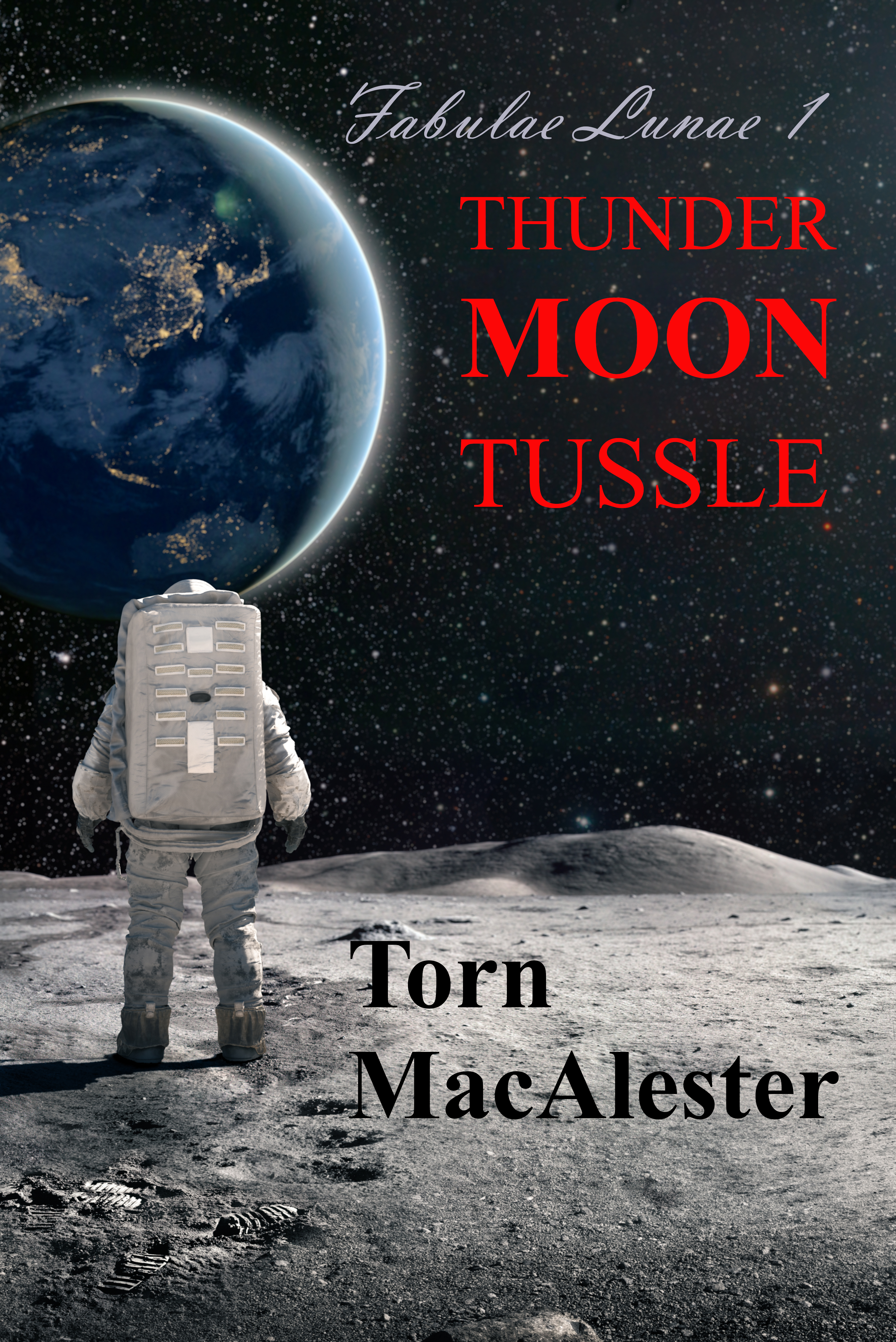
- Thunder Moon Tussle
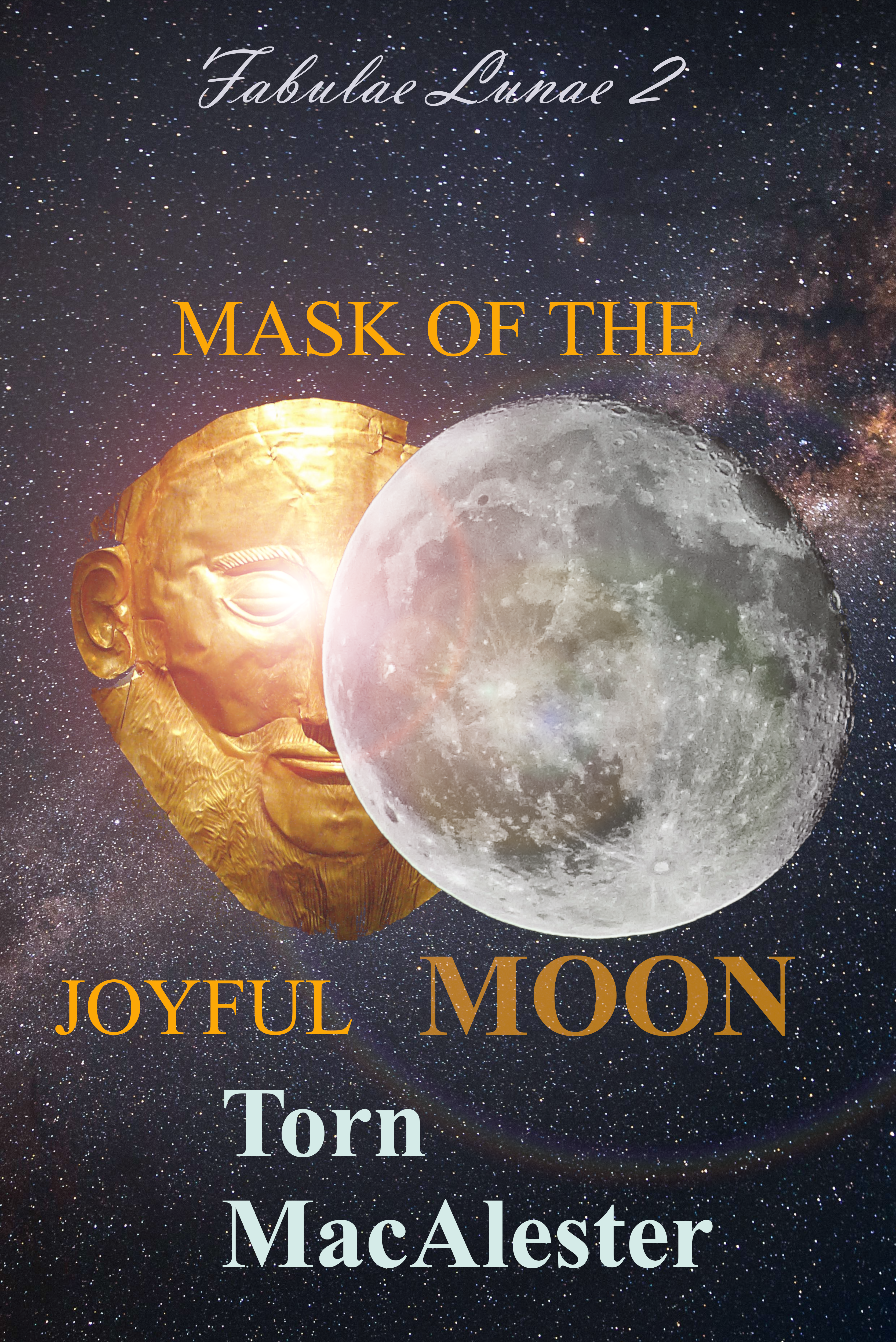
- Mask of the Joyful Moon
- Related site posts: Character Spotlight – Nils Carmike, Nils Carmike (Revisited), The Landing at Fra Mauro, EVA Reality, The Water Economy
The Joyful Moon is still watching…
and some shadows still hold water.
— Torn MacAlester
Still riding the trails with Nils, Gen, and the whole Fabulae Lunae crew
🚀🌕
 |
 |
 |
|
StoriesThe stories of Torn MacAlester are science fiction, where the science is well-grounded. I intentionally made any deviations for speculative purposes. To maintain maximum realism, I restrict the scope of these deviations. |
ArticlesI write articles of science fact and science fiction. The articles here span the knowledge of modern science and the speculations of fiction. I try to caveat everything that is an assumption. You will find articles about spaceflight, the possibilities of alien contact, and descriptions of technology used in my stories. |