Hard Tech & Science — Storm Cellar
Hard Tech & Science – Storm Cellar
A CME alarm, a cellar under Hab D, and the water stacked over your head while 100 MeV protons arrive.
Moon base hard science fiction: air, water, power, and the narrow buffers that keep the Habs alive.
A coronal mass ejection does not care that Conrad Station has air, power, or a sheriff. The particles that matter are protons at about a hundred million electron volts, moving near forty percent of the speed of light, and they stop in whatever mass they hit first. Eight minutes after the alarm, Doc Keller’s monitor reads more than four thousand of those protons per square centimeter per second, and rising. If that flux meets a body before it meets water, regolith, or the crater wall, the body is the shield. Earth habit says a storm cellar is a hole you climb down into. On the Moon the hole is only as good as the mass between you and the Sun.
The Constraint
The warning is a light-time fact, not a local instrument. Earth sees the ejection and broadcasts the alert. The worst protons are still in transit. Sheriff Anderson spends the clock in one sentence: Hab D, the cellar, eight minutes, or your insides turn to jelly. That is the whole decision. No bag. No tab. A sliding run in one-sixth gravity, because a bounce off a bulkhead knocks you out before you are under anything.
What kills the newcomer is the Earth picture of “down.” Down is not a direction the particles respect. Nils says it in the cellar when someone wants the floor left alone. The radiation they are hiding from is coming from one direction. Shielding under your boots may cut the slow dose from the crust. It does nothing to a solar proton event unless it sits between you and the source. The habs were not designed for the Moon. They were built for space, where the dose can come from any side, so the foam went in the floor as well as the ceiling. On this day the floor foam is spare parts. The ceiling is the shelter.
The other Earth habit is treating water as plumbing. In the room above the Hab D cellar, most of the station’s water storage is stacked over the people who made it inside. Water is life support on every other day. For these hours it is column density. Foam blocks go over the hatch after McPherson dogs it, strapped so they cannot shift. Regolith, piled up the sides of Hab D in the original build, makes the hab effectively underground against anything coming in sideways. None of that is a meter reading anybody posts on the wall. It is mass in the right place, and it is only in the right place if you are under it when Doc calls the increase.
How It Works at Conrad
The architecture is ugly because it was inherited. Four early habs. Hab D is the one they bermed. The cellar is not a bunker poured for solar max. It is a volume under a water tank, under foam, inside a regolith skirt, with a hatch somebody still has to close. Twenty-five people make it down. The Ocean of Storms count that night is about thirty. The missing five are the system showing its edge: a phone net that stops at the ridge, a hab cellar that is not this one, a man in London who does not need the warning.
Nils has already used the cheaper versions. Once he rode a CME out in his own hab, in a room under regolith. Once he drove a crawler into a crater and put the wall between the cabin and the Sun. Shade is not armor. It is geometry. If most of the particles are coming from the solar direction, rock you cannot carry is still rock. A crawler is not a cellar. It becomes a poor one only after they pull the useless floor foam out of Hab D and strap it where the Sun will hit it first. McPherson gives the order to dig the shielding up. Doc does not argue the volunteer slot. Tilly Masters is not on the net.
Power and air do not get a vote while the hatch is shut. The recyclers keep their hum. The seals hold or the cellar is just another room. None of that stops a proton. The crackers and the batteries matter before the alarm and after the all-clear, when the station has to be a station again. During the event the only machines that count are the monitor in Doc’s bag, the phones that still reach a tower, and the crawler that can carry stolen foam down the South Road without shedding it on the rocks. At ten kilometers an hour the crawlers are all-terrain. At twenty they are a bet. Tilly’s own bet, heading for shade at the base of a cliff, costs her closer to fifteen minutes than five because the road is stones. Those minutes are dose.
What Fails First
The person outside fails first. Not the hatch. Not the water. Tilly Masters, out toward the southwest site after a KREEP outcrop, behind a mountain, off Conrad’s tower. Nils gets no connection. Vargas, closer, is the relay. Doc has already told Tilly to eat whatever painkillers and stimulants are in the med kit and to take a sleeping pill. By the time the crawler is rolling, the pill has won and the phone has not.
Doc is the one who notices the particles, because she would not enter the cellar without the monitor. Nils is the one who notices the geometry, because he has already hidden behind a crater wall and knows the floor foam is facing the wrong sky. The sheriff notices the count. Twenty-five in the room. Five names. One of them does not answer.
The three-day lag does not slow the protons, and it does not bring a ship. Earth sent the alarm. Earth cannot send the mass, the doctor, or a road that is not rocks. The repair, if it is a repair, is local: foam pulled out of the floor, a crawler pointed so the shield stays between the cabin and the Sun, a detox panel for kidneys that are about to meet ionized tissue, and a prospector code that fits in one word. Survive. Treating the damage is new to Doc. She says so. Nano-tags and a guess about cells that look like cancer are what she has in the bag, not a ward. Organs fail after the flux falls. The cellar does not stock spare marrow. A printer and a collagen skeleton are a conversation in the bar after, not a part on the shelf when the South Road is still under fire.
The water over their heads holds for the people who clicked the hatch. It does not follow a crawler past the ridge. When the Sun is the source and the tower is the horizon, what is actually between Tilly and the protons besides a cliff she may not have reached?
Further Reading
- The Lunadyne Incident and Other Stories — “CME”
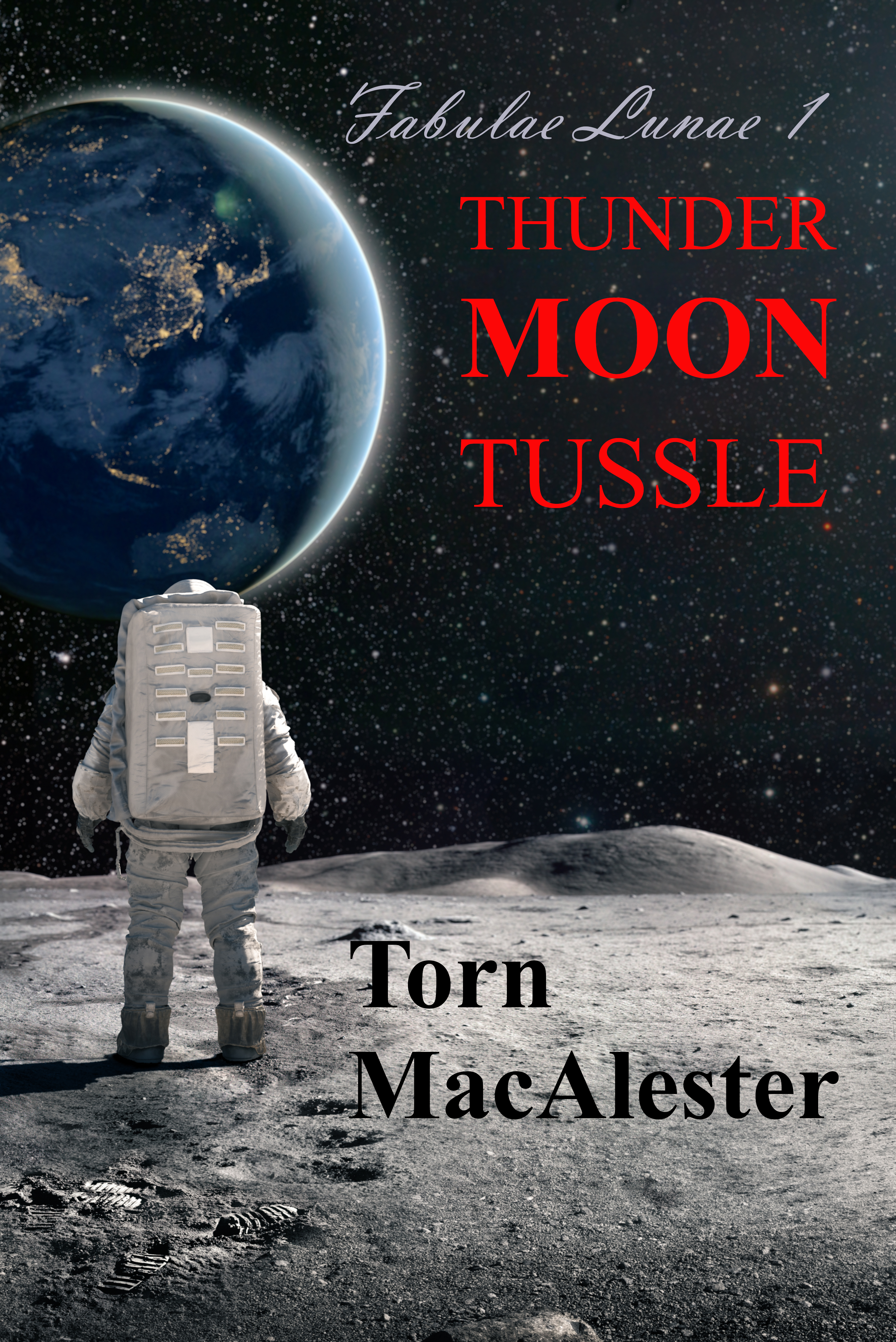
- Thunder Moon Tussle
- Mask of the Joyful Moon
- Related site posts: Life on the Frontier — When the Alarm Sounds, Legends and Lore — Hab D, Hard Tech & Science — Eight Minutes, The Sound of the Recyclers, The Three-Day Lag
The Joyful Moon is still watching…
and the margins still have to hold.
— Torn MacAlester
Still riding the trails with Nils, Gen, and the whole Fabulae Lunae crew
🚀🌕
 |
 |
 |
StoriesThe stories of Torn MacAlester are science fiction, where the science is well-grounded. I intentionally made any deviations for speculative purposes. To maintain maximum realism, I restrict the scope of these deviations. |

ArticlesI write articles of science fact and science fiction. The articles here span the knowledge of modern science and the speculations of fiction. I try to caveat everything that is an assumption. You will find articles about spaceflight, the possibilities of alien contact, and descriptions of technology used in my stories. |