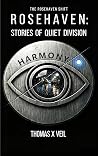
 Rosehaven: Stories of Quiet Division by Thomas X Veil
My rating: 4 of 5 stars
Thomas X. Veil sets his collection of linked short stories, Rosehaven, in the dystopian town that shares its name, a place that appears ordinary until you observe how tightly the community holds it together. Across the stories, residents go about grocery runs, night shifts, and family dinners while the town’s rules quietly decide who is safe, who is useful, and who can disappear with no one asking questions because the factions control everything. Veil builds Rosehaven through accumulation rather than a single plot: a factory that never quite shuts down, a neighborhood watch that watches too closely, a rumor that becomes policy. Characters return from one piece to the next, sometimes as protagonists and sometimes as figures in the background, and the collection reads like a map of the same streets seen from different windows. The result is less a set of isolated tales than a portrait of a community learning, slowly and at cost, what kind of place it has agreed to become.
Some stories in Rosehaven were genuinely fascinating, and every one of them was intense. The collection does not coast on atmosphere alone: it keeps returning to questions of loyalty, desire, power, and what people will risk when the safe choice is no longer available. Even the quieter pieces leave a residue. You finish a chapter and turn the same scene over, wondering who was telling the truth and what the cost of that truth really was.
In Rosecode, David tries to become a spy for the New Tomorrow faction in their fight against The Return. He’s new, but thinks himself an excellent potential spy and wants to infiltrate The Return’s facility to steal their codebook. The plot is delightful, ingenious, and well constructed, making David’s naive attempts both predictably a failure and unpredictably a success at the same time. This marks the skill Veil poured into the stories of Rosehaven. The adult material is unmistakable.
There is violence, sexuality, moral compromise, and the emotional cruelty that does not need a lecture to register. None of it feels tacked on for shock. The author maintains control in the writing. The writer uses graphic detail when it serves character or consequence; then he steps back. What you get is a mature outcome without luridness: understanding what happened and its importance without having to endure excess. That balance makes Rosehaven linger. It is not a light read, and it does not pretend to be. It is a set of stories that trust the reader to handle difficult subjects, then repay that trust with craft, tension, and ideas worth carrying after the last page. I rate Rosehaven four stars. These stories solidly build around a common theme.
View all my reviews