On the Moon, water is not a resource. It is currency, leverage, and life itself.
At Conrad Station, every liter is accounted for. Every drop that leaves a recycler, every frozen gram mined from the poles, and every shipment delayed from Earth carries weight far beyond its mass. In one-sixth gravity and hard vacuum, water is the single most important commodity that determines who thrives, who merely survives, and who eventually leaves — or dies.
The Numbers Behind Survival
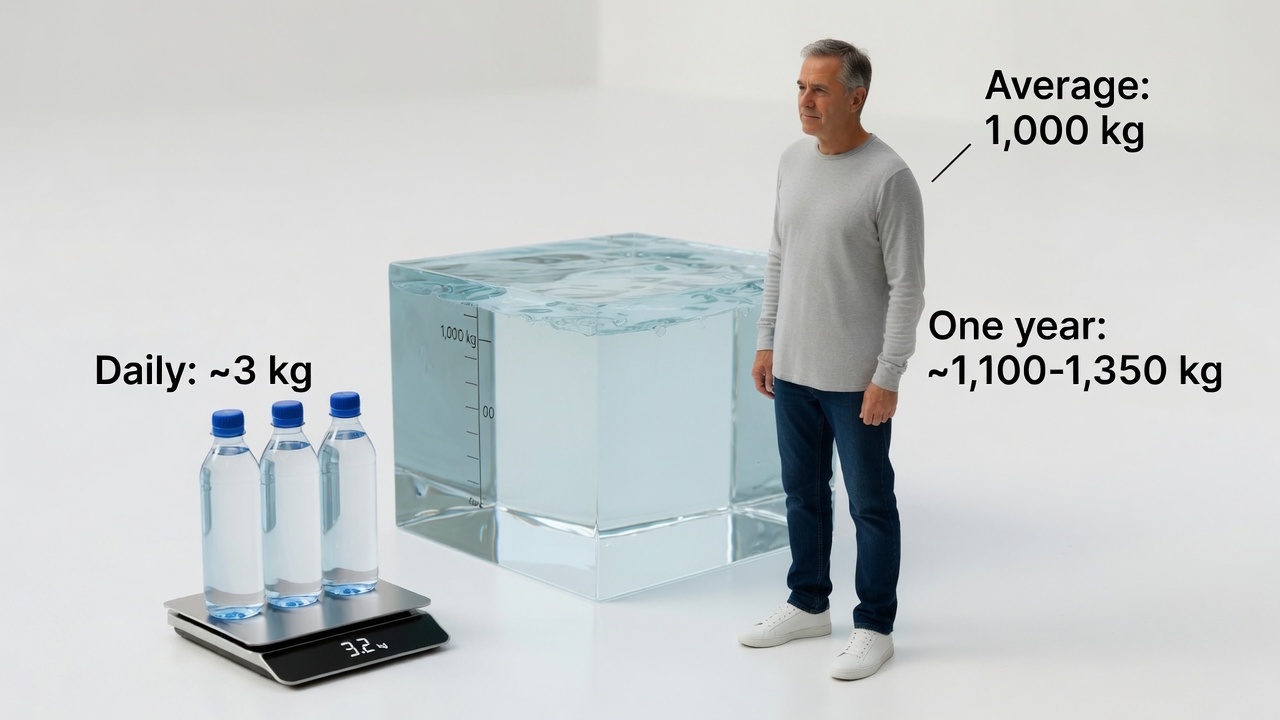
An average adult consumes between 1,000 and 1,350 kilograms of water per year. On the Moon, without aggressive recycling, that figure would require constant, expensive resupply from Earth. Every kilogram launched from the bottom of Earth’s gravity well is costly. The economics become brutal very quickly.
Closed-loop recycling changes the equation. When a station can reclaim the vast majority of its water from breath, sweat, and waste, the net amount that must be imported drops dramatically. That efficiency is what allows more people to live on the Moon for the same mass of water shipped from Earth. It is the purest form of economy of scale on the frontier: better recycling means higher population capacity without a matching increase in Earth-launched mass.
This is why the performance of the recyclers is watched so closely at Conrad Station. A small drop in efficiency does not just waste water — it reduces the number of people the station can support. In a place where every additional resident brings both labor and risk, that calculation is never abstract.
Poles vs. Equator – Lunadyne’s Bet
Many early plans for lunar settlement focused on the poles. Permanently shadowed craters offered the most accessible ice, and the peaks of eternal light offered continuous solar power. Most serious concepts treated the poles as the logical first foothold.
Lunadyne made a different bet.
They chose an equatorial site for what became Conrad Station. By locating away from the polar ice, they accepted a heavier reliance on imported water and aggressive recycling. Their calculation appears to have been that they could still make the numbers work — and that the equatorial location offered other advantages that would ultimately outweigh the water penalty.
Possible strategic reasons that fit the hard-SF framework of the series include easier access from Earth orbits (lower plane-change costs), the ability to serve as a logistics and processing hub, access to usable regolith resources, and a desire to avoid the early political contests forming around the most valuable polar real estate. In The Lunadyne Incident we begin to see the consequences of that corporate decision. The water situation is tighter than it would have been at the poles, which raises the stakes of every recycling failure and every delayed shipment.
Power, Contracts, and the Three-Day Transportation Lag
Because water is so valuable, control of it becomes political. Corporate entities — including the long reach of the Mason family and earlier players like Lunadyne — understand this perfectly. Water allocation can be used as quiet pressure. A delayed shipment, a revised contract, or a “temporary” reduction in recycling capacity can force compliance without a single open threat.
The critical constraint is the transportation lag. You can tell Earth you have a problem almost immediately. What you cannot do is make physical help arrive any faster than physics allows. Even if the needed parts, water, or personnel are sitting on the pad ready to go, it still takes roughly three days for anything physical to reach the Moon. Advice can come quickly. Actual assistance cannot.
That three-day window is where a lot of lunar power is exercised. By the time a shipment or replacement arrives, the local situation has already been forced to resolve itself — one way or another.
Daily Life Under Scarcity
You see the water economy in the smallest details. Showers are short and scheduled. Straw-cups of coffee or beer are measured. Even the steam from a hot meal is noticed. In Thunder Moon Tussle, the casual way characters talk about water reveals how deeply the scarcity has shaped their thinking. In The Lunadyne Incident, the early struggles over resources foreshadow the more sophisticated power plays that come later.
Water is also a social marker. Those who waste it are marked as green or reckless. Those who guard it carefully earn quiet respect. And those who control it — even indirectly — hold a form of power that no badge or corporate title can fully match.
The Quiet Truth
The lunar frontier was supposed to offer a kind of independence from Earth’s old hierarchies. In practice, the water economy has become one of the strongest ties binding Conrad Station back to Earth. Every recycled liter and every polar ice shipment is a reminder that true self-sufficiency remains just out of reach.
That tension — between the dream of independence and the reality of scarcity — runs through the entire Fabulae Lunae series. It shapes decisions, alliances, and the quiet desperation that sometimes surfaces in Alex’s Bar after a long shift.
On the Moon, you can live without many things. You cannot live without water. And that single fact continues to shape everything.
Further Reading
- The Lunadyne Incident – Early resource struggles and corporate pressure.
- Thunder Moon Tussle – Daily life under scarcity and the culture that forms around it.
- Mask of the Joyful Moon – How water and power continue to influence events under Gen Miller’s watch.
The Joyful Moon is still watching… and every liter still counts.
— Torn MacAlester Still riding the trails with Nils, Gen, and the whole Fabulae Lunae crew 🚀🌕
Mask of the Joyful Moon Trailer
Stories
The stories of Torn MacAlester are science fiction, where the science is well-grounded. I intentionally made any deviations for speculative purposes. To maintain maximum realism, I restrict the scope of these deviations.
Articles
I write articles of science fact and science fiction. The articles here span the knowledge of modern science and the speculations of fiction. I try to caveat everything that is an assumption. You will find articles about spaceflight, the possibilities of alien contact, and descriptions of technology used in my stories.

Outpost
Blog, Reviews, Schedule, Comment Thread, & Reader’s Group.
Read More